Interview with Henryk Börngen from Continental #TalkMarTechToMe

As Global Head of Marketing Smart Mobility at Continental, Henryk Börngen is a true MarTech expert. So it’s time to talk to him about the status quo, challenges, and the new responsibilities for CMOs.

T

ransformation seems to be one of Continental’s core competencies. Many people probably think exclusively of a tire manufacturer when they hear the name of the more than 150-year-old B2B company. But that hasn’t been the case for a long time: tires are just one business unit alongside Automotive and ContiTech – and the technology company can be assigned to many different business fields, such as Autonomous Mobility, Smart Mobility, User Experience, Conveying Solutions, Surface Solutions (more information about Continental’s group structure can be found here).

Behind the strong Continental brand lies a true B2B giant – with 37.7 billion euros in revenue, one of the world’s largest automotive suppliers. This makes Continental’s marketing work all the more demanding, with many challenges, changes, and new perspectives. Processes and strategies are regularly evolving here – keyword: the technologization of marketing.

Henryk Börngen from Continental and Matchilla CEO René Kühn regularly engage in open discussions about current trends in marketing and new software providers. For MatchZINE, the two met via Zoom to capture the current status quo in marketing.

René Kühn: Dear Henryk, it’s great that we’re once again talking about the current challenges, and welcome to our “MarTech Talk” format. The good thing is that B2B is always two years behind, so you can simply look at the 2024 scenario with B2C marketers to see what’s current. Or how do you see it?

Henryk Börngen: Hello, dear René, nice to see you. You’re starting with an interesting thesis, and I agree with you—until a few years ago, the gap was even bigger in some marketing and especially MarTech aspects. I remember a conference a few years ago where a B2C data specialist talked about performance marketing. Most B2B companies certainly still can’t operate at that level today. But the requirements and objectives are changing fundamentally right now. Driven by changing customer requirements, multi-channel sales strategies, new business models (keyword: servitization), and continued cost pressure, there is a clear increase in speed and catching up.


René Kühn: In this context, would you briefly explain which division at Continental you work in and what you do all day? Which areas are under your leadership?

Henryk Börngen: For some time now, I’ve been wearing two hats. Under the first are the diverse marketing activities of the Automotive business unit for the business fields: Smart Mobility, Aftermarket, and Commercial Vehicles. This includes brand communication for our product brands ATE, Continental, and VDO; the trade and performance marketing activities of the multi-stage after-sales distribution; and live marketing with international trade fairs and (digital) customer events and webinars. Under the second hat are efforts to optimize the customer journeys as well as all customer touchpoints and the corresponding processes. This means expanding the go-to-market tech stack for eMarketing, eCommerce, and e(Self)Service.


René Kühn: When you talk to B2B marketers, it usually doesn’t take longer than 60 seconds before someone says “…in our change process” for the first time. Can you give us an insight into which key changes in marketing are currently the biggest challenges for you?

Henryk Börngen: I see several challenges here. For one, putting our customers much more at the center (outside-in view), viewing data as the “new currency” for offer and self-optimization. But also achieving the necessary balance between investment in MarTech and brand value, as well as being attractive to new talent and further developing capabilities in digital marketing.


René Kühn: Keyword MarTech. In your opinion, how are technologies and innovations in the software and tools space changing the game for B2B marketing teams? Where do you see the decisive advantages and benefits for your marketing?

Henryk Börngen: We’ve made it our mission to increase convenience for our customers, for example through better UX, self-service offerings, or SSO, and to further reduce our own costs for this through comprehensive digitalization and automation. In addition, we are pursuing additional revenue sources, such as further digital sales channels, so that we can also serve smaller customer accounts. Not to forget, data-driven optimization and reduction of customer acquisition costs, in an environment of rather rising advertising costs at Google, Facebook, and the like. The growth field of license or service business is enabled by the newly built service portals, where personalized offers and self-service drive new business and upselling.


“Speed in implementations is more important to us than the best solution, which is already outdated by the time it’s released.”

René Kühn: Over the past months and years, you have developed the infrastructure for a Continental MarTech stack. Every company surely has to implement this very individually. What did you use as your point of reference? Can you give us some insight?

Henryk Börngen: When it comes to TechStack, there are certainly many philosophies. We have been working for three years on building our technical go-to-market infrastructure. With our approach, it is important to us to break down silos and, where possible, to centralize solutions or to be able to scale quickly using blueprint solutions. In a corporation with an extensive digital history as well as a wide range of IT responsibilities, the chosen approach is more of a “brownfield,” but speed of implementation is more important to us than the best solution—which is already outdated by the time it is released. We have had very good experiences with MVPs and an incremental approach.


René Kühn: And what is currently—and especially in the future—the task and requirements profile of a CMO? What will the CMO role look like in 2025?

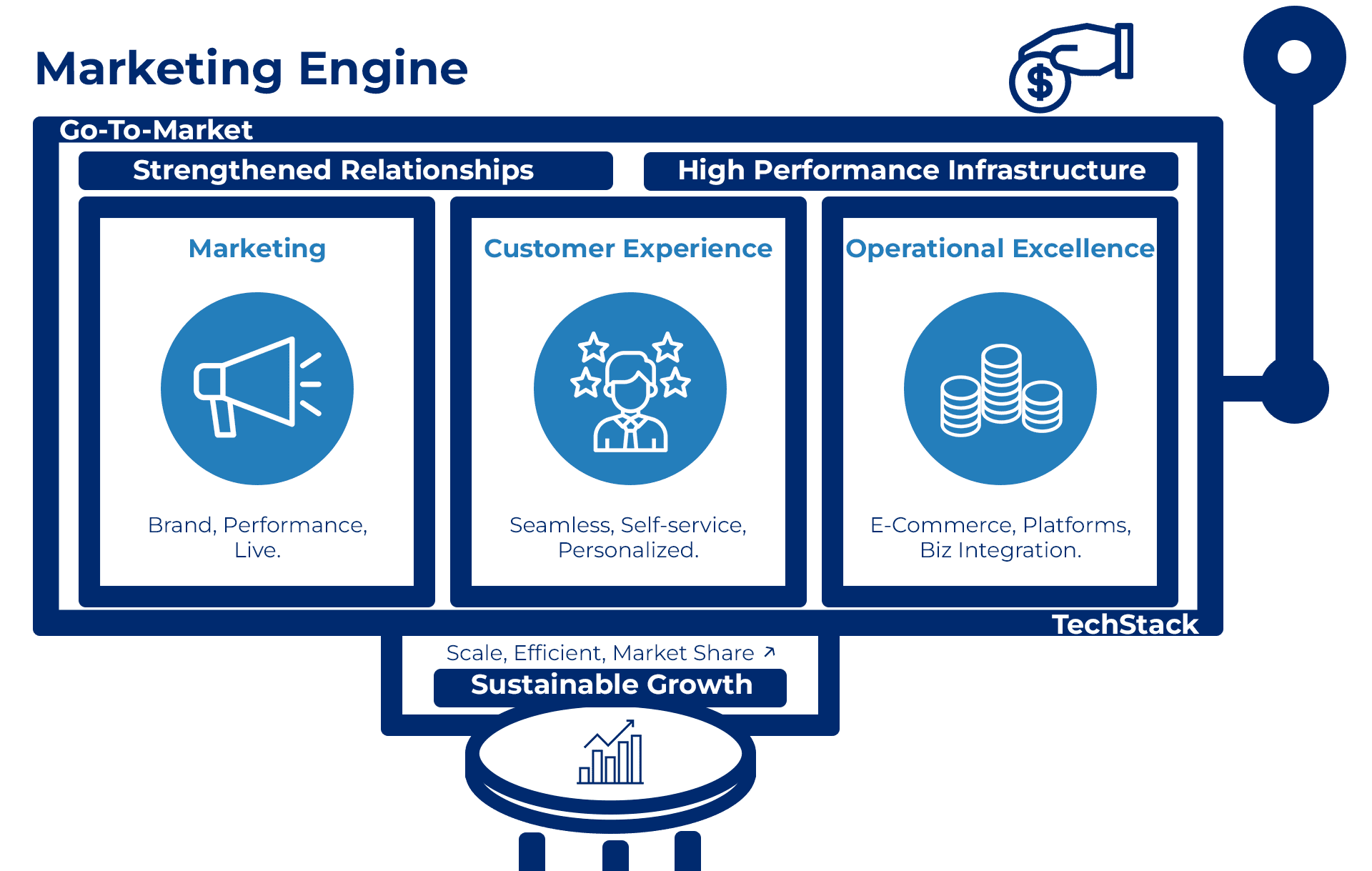
Henryk Börngen: Future CMOs will need to be able to strengthen their customer relationships and maintain a high-performing MarTech infrastructure. To ensure sustainable growth, operating the marketing engine and the areas of marketing, customer experience, and operational excellence will become essential. This graphic shows how marketing and technology are merging and which aspects may be relevant in the process.

MTC-MarTechStack-Continental
The “Marketing Engine” by Henryk Börngen: In the future, CMOs must be able to cover the areas of marketing, customer experience, and operational excellence.

René Kühn: With your really strong LinkedIn posts over the past months, you have become a real opinion leader and educator in the MarTech space. Many other marketers comment and discuss your topics. How do you perceive marketing colleagues from other companies? Do you think everyone has recognized the signs of the times?

Henryk Börngen: My wish here is to build a network with like-minded people and to continue developing through the shared dialogue. In my opinion, no marketer can avoid MarTech anymore—and the vast majority have recognized that. Topics such as CRM, automation, testing, personalization, performance, analytics, marketing data are already drivers in marketing today. Marketing technology will be the measure of all things in the future and a differentiating factor for excellent companies and CMOs. Now it’s about developing as a marketer and building the corresponding competencies. At Continental, we use a wide range of offerings, such as seminars, conferences, and webinars, to stay up to date.

»I would like us to dare to approach the topic of MarTech faster, more experimentally, and less holistically.«

René Kühn: Once again, back to MarTech. Which three things would you like to solve in the current process with a snap of your fingers?

Henryk Börngen (laughs): A colleague recently coined the following saying: “Ironically, digital transformation is not a technological problem.” I would add: most of the time it’s the human factor that makes change more difficult. With a snap of my fingers, I would wish that…

  1. we dare to address the topic of MarTech faster, more experimentally, and less holistically,
  2. we further expand our constructive culture of learning from mistakes, and
  3. we develop a shared understanding of the importance of data.


René Kühn: Speaking of snapping your fingers. The enchanting Jeannie returns as AI and offers you the ability to program three skills and use them personally at any time. Will you tell us which ones?

Henryk Börngen: Upgrading my RAM would be enough for me (laughs again). In business, AI could help enable customer segmentation of marketing target groups using cluster algorithms. AI could also help determine customer lifetime value to enable better marketing budget and campaign planning. AI would also be desirable for returns optimization in e-commerce, for example through an assisted sales process. And if Jeannie can’t after all, then we’ll implement it ourselves—maybe not everything immediately.


René Kühn: Dear Henryk, thank you very much for this conversation and your insights. We’re already looking forward to your next posts on LinkedIn.

Don’t miss any more MarTech insights from CMOs

Matchilla - Matching-Plattform und Marktplatz Top news from the Matchilla MatchZINE – the MarTech magazine


Matchilla - Matching-Plattform und Marktplatz Tips & tricks on how to use the right marketing technologies

Matchilla - Matching-Plattform und Marktplatz Best practices from other marketing decision-makers when it comes to MarTech

Matchilla - Matching-Plattform und Marktplatz and much more!

Picture of Henryk Börngen
Henryk Börngen

Henryk Börngen started in corporate communications at Siemens VDO, was Head of Communications in Automotive Aftermarket at Continental, and now leads global marketing for the Smart Mobility business area at the technology company. His passion is not only for strategic brand building and performance marketing, but also for sustainability and new business models.

In a second role, he has been driving technological and cultural change at Continental since 2019 as Project Lead Digital Transformation, to increase customer focus by expanding and automating digital sales and service channels.

More MarTech articles from the Matchilla MatchZINE

Match me if you can!

Matchilla revolutioniert die Auswahl neuer Dienstleister mit einer effizienten Kombination aus Daten, persönlicher Kompetenz und strukturierten Prozessen. Probiert Matchilla kostenlos und unverbindlich aus und lasst das Matching zu einer eurer liebsten Beschäftigungen werden.