AI agents – select providers and platforms according to your criteria

Want to use AI agents effectively to automate your processes? We support you with well-founded insights when selecting the right tools and with an individual vendor matching based on your criteria!

Bahlsen Logo
DB Schenker Logo
Reuter.de logo 175x53px
Ssi Schaefer Logo 175x53px
Fidelity international logo 175x53px
TimoCom Logo
Gerry Weber Logo
igus Logo
O

ver the past month, the tech market has changed noticeably: AI agents are giving companies new opportunities to optimize their processes—from more efficient workflows and targeted resource savings to the development of new business models.

At the same time, the market is highly dynamic, confusing, and not very transparent. Identifying the right AI agent solution thus quickly becomes a time-consuming challenge.

That’s why we’re sharing our know-how from our agent matchings for SMEs and large enterprises, giving you a structured overview of the market and key decision criteria, and helping you find the tool that fits you and your company’s requirements through an individual provider comparison!

Matchilla - die drei Schritte im Matching

Which platform for AI agents is right for you?

Would you like to dive deeper into the topic of AI agents? Then you’ll find all the relevant information here. Alternatively, you can start our free matching right away to identify exactly the AI agent platform that fits your individual requirements:

👉 Go directly to AI agent matching

Why are AI agents in such high demand right now?

Artificial intelligence has become an integral part of operational value creation in 2025. While many companies are still considering how to integrate tools like ChatGPT, Perplexity & Co. into existing processes, a new field has emerged in parallel: AI agents. These systems take on tasks independently, prepare decisions, and act autonomously. They are not merely an evolution of classic automation; they represent a fundamental shift in concept.

This gives rise to a new delivery model: Instead of laboriously automating processes, tasks are delegated to systems that act independently. AI agents relieve organizations, shorten response times, enable 24/7 operation, and open up new business models—for example, through always-available service units or data-driven product support.

Overall, this means: Work becomes more hybrid; teams will increasingly consist of people and AI agents. Manual processes become scalable, tasks can run in parallel without friction, and are distributed dynamically. At the same time, responsibilities are changing. Governance, monitoring, and the competence to work with intelligent systems become central when dealing with AI agents.

And it is already becoming clear that this solution works. Many companies are already deploying an AI agent on their websites and integrating it into their processes. And interest in market-ready solutions is rising rapidly. Companies are no longer looking for experimental models, but for reliable providers and privacy-compliant platforms that deliver integrable AI agents and make work in their operations more efficient.

DACH market overview: Which use cases can be implemented?

The market for AI agents is still very young, but it has developed disproportionately fast due to the advancements around AI. Accordingly, there is no clearly defined vendor landscape, but rather a large number of different players from various fields offering AI agents. Especially for companies looking for specific use cases and not getting much value from blanket promises like “we can do everything,” it is necessary to structure the market and filter in a targeted way.

For our overview, it should be noted upfront that this is not a comprehensive market overview. The market for AI agents is changing so dynamically that with every update, new providers or use cases are added.

However, through our matchings, our team has been able to gain a very detailed insight into the German-speaking AI agent market—especially into solutions that are relevant for SMEs and large enterprises.

At this point, we would therefore like to give you an overview of the two most important types of AI agents:

Matchilla - Auflistung SCM-Anbieter Customer support agents
Customer support agents are currently the most widespread and most frequently used type of agent. Accordingly, a broad vendor market has already become established. The agents handle customer inquiries along clearly defined service processes and operate across channels. They understand requests in context, draw on existing company knowledge, and independently guide inquiries through to resolution or handover to a service representative.

Matchilla - Markt SCM-Anbieter HR agents
These AI agents are used to support operational, personnel-related tasks and relieve HR departments in strongly process-driven areas. They are primarily used where workflows are clearly defined—such as in recruiting, onboarding, internal inquiries, or administrative services. HR agents serve as operational support, consolidate information, and initiate processes without replacing HR’s strategic role.

In the DACH region, it is becoming clear where the journey with AI agents is heading: Companies are relying less on experimental jack-of-all-trades and more on clearly controllable, specialized solutions.

In particular, AI agents are in demand that can be cleanly integrated into existing systems, improve specific processes, and work reliably, transparently, and in compliance with data protection regulations. Topics such as governance, transparency, quality and control carry significantly more weight here than in many other markets.

Functions: What does an AI agent do?

AI agents differ fundamentally from familiar automation approaches. They are not designed to execute individual commands or rigidly defined sequences, but rather to achieve a goal independently. To do so, they combine language understanding, process logic, data access, and tool control into a continuous model of action.

The key difference lies in autonomy: An AI agent doesn’t just carry out what is specified; it decides for itself which steps are necessary to achieve the previously defined goal. This enables it to gather information, plan intermediate steps, prioritize decisions, ask follow-up questions, and evaluate results. Feedback and notes provided actively flow into its further approach and help improve performance.

For companies, this means in concrete terms: A deployed AI agent does not take on isolated tasks, but entire sections of a process. It works toward clearly defined goals, operates within predefined rules, and integrates into existing systems. Which functions are covered in detail depends heavily on the use case and the provider’s particular focus.

What this works like in practice can be clearly shown with the two use cases (mentioned in the previous chapter):  

Matchilla - Auflistung ASiG-Softwarefunktionen Customer support agent
A customer support agent takes over recurring and time-consuming tasks across the entire support process. The most central function is the automated handling of customer inquiries across various channels such as email, chat, or ticketing systems. The AI agent analyzes incoming requests, recognizes concerns, priorities, and urgency, and assigns them to the appropriate categories.

On this basis, it can independently formulate responses, access existing knowledge bases, or incorporate relevant information from connected systems (e.g., CRM, ERP, or product databases). In more complex cases, the agent decides when a handover to a human support employee makes sense and prepares this handover in a structured manner—including a summary, context, and suggested actions.

In addition, a customer support agent follows up on tickets, shares status updates, asks relevant follow-up questions, and learns from feedback. The goal is to shorten response times, relieve support teams, and at the same time ensure consistent, traceable customer communication.

An engineering company with around 300 employees received numerous support requests every day regarding spare parts, maintenance intervals, and error codes. Many of these requests were repetitive, but time-consuming to process because the required information was spread across ERP systems, PDF manuals, and internal databases.

To relieve the support team, the company implemented an AI agent as a digital service assistant. The agent analyzes incoming emails and chat messages, identifies relevant parameters such as machine type or fault pattern, accesses the appropriate documents, and derives concrete recommended actions from them – including spare part numbers and maintenance notes.

If the agent can answer a request completely, the response is sent directly to the customer. For more complex issues, it automatically creates a structured ticket for the service department and enriches it with all relevant context information. This reduces follow-up work and makes the handover efficient.

After six months, the results were clear: around 65% of standard inquiries were answered autonomously, and the average response time improved by more than 40%. At the same time, the support team was able to focus more on technical special cases.

Matchilla - Auflistung KI-Agenten-Beispiele HR agents
An HR agent supports HR departments across various phases of the employee lifecycle. In recruiting, it analyzes incoming applications, matches profiles with requirements, and creates structured pre-selections. In doing so, it takes defined criteria into account and supports documentation and the comparability of decisions.

As the process continues, the AI agent handles communication with applicants, coordinates appointments, answers standardized follow-up questions, and organizes feedback loops. Internal processes such as onboarding, contract administration, or answering standardized employee inquiries can also be effectively supported and managed by an HR agent.

In addition, an HR agent supports workforce planning through qualified data analysis. It analyzes data from various HR systems, prepares evaluations, and flags bottlenecks or anomalies.

The agent does not replace an HR function; rather, it provides operational support, reduces manual effort, and thus creates capacity for strategic tasks.

A services company with around 700 employees found its HR department under increasing pressure. A high volume of applications, intensive communication needs, and an onboarding process spanning multiple systems resulted in very intensive manual effort. To relieve these processes, the company implemented an HR agent that took over two core areas of responsibility: recruiting and onboarding.

In recruiting, the agent analyzes incoming applications from various channels such as email, PDF documents, or LinkedIn. It extracts relevant information, matches profiles with the requirements of the respective position, and creates structured shortlists. In doing so, it points out potential risks (such as missing competencies) and suggests targeted follow-up questions.

In addition, the agent takes over ongoing communication with candidates: scheduling, follow-ups after interviews, answers to standard questions, and reminders about missing documents. From the applicants’ perspective, the process felt faster and clearer, without the AI-based support being explicitly noticed.

In onboarding, the agent creates individual onboarding plans based on role, location, and team affiliation. It automatically coordinates necessary steps such as IT access, account creation, equipment requests, booking appointments for introductory meetings, providing guidelines and welcome documents, and mandatory training courses including reminders. The HR team only steps in where approvals are required or exceptions need to be handled.

After implementation, operational effort in the HR department decreased significantly. Standard processes ran consistently and transparently, while the team shifted its focus more toward personal conversations, decision-making, and strategic HR topics.

What you absolutely need to understand when getting started with choosing the right AI agent provider:

Aufzählungszeichen KI-Agenten - das musst Du über Anbieter wissen There is no such thing as THE AI agent provider: The market is too young, too dynamic, too heterogeneous.
Aufzählungszeichen KI-Agenten - das musst Du über Anbieter wissen The differences between providers are significant: Some build truly autonomous agents. Others sell automation workflows with AI components. Both can work – but they are different products.
Aufzählungszeichen KI-Agenten - das musst Du über Anbieter wissen Many providers are still in phase “1.0”: They are good, but not always stabilized. That’s why piloting is more important than searching for “the perfect provider.”
Aufzählungszeichen KI-Agenten - das musst Du über Anbieter wissen - Budget Success depends more on the setup than on the provider: Use case, data access, responsibilities, monitoring – these often matter more than the provider itself.

Investment and budget: How much does an AI agent cost?

The first question everyone asks: How much is the investment? And unfortunately, the answers are often far too vague. Based on our previous matchings for the DACH region, however, a practical, realistic cost range can be given: An AI agent costs (depending on scope) between €500 and €25,000 per month. This wide range results from the type of agent, how thoroughly it is developed, and the intensity of use.

The biggest cost drivers in providers’ calculations include, among others:

Aufzählungszeichen KI Agenten - Kosten Complexity of the tasks
Aufzählungszeichen KI Agenten - Kosten Integration into existing systems
Aufzählungszeichen KI Agenten - Kosten Data connectivity and interfaces
Aufzählungszeichen KI Agenten - Kosten Monitoring and operations (observability)
Aufzählungszeichen KI Agenten - Kosten Legal and regulatory requirements (compliance)
Aufzählungszeichen KI Agenten - Kosten Usage (number of requests, tokens, API load)

The following table provides guidance on licensing costs as well as the initial implementation effort (including internal project costs):
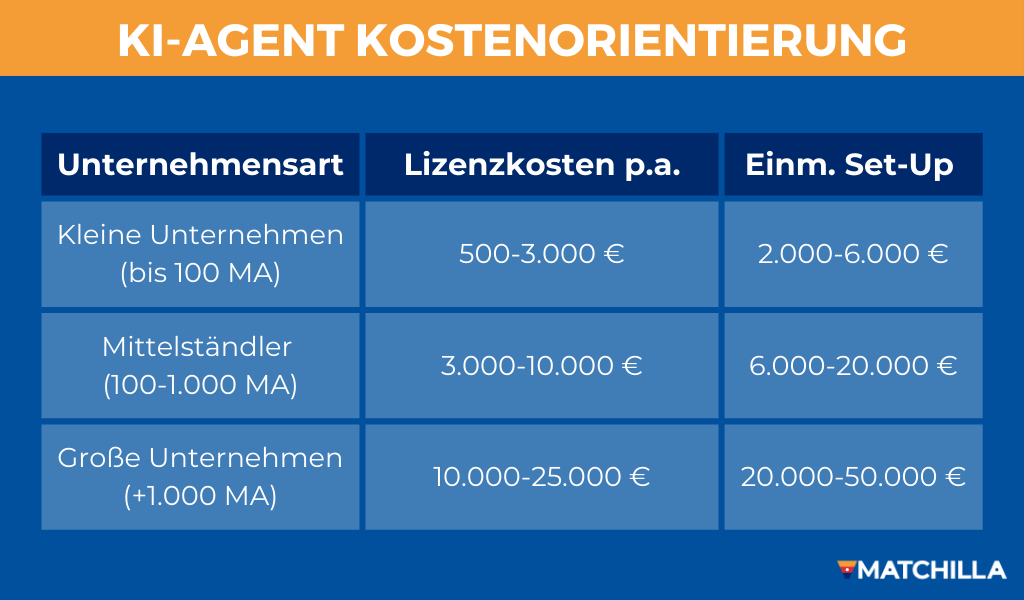

Kostenübersicht zu KI-Agenten

What matters, however, is this: Focusing purely on costs falls short. AI agents are used to make processes more efficient and achieve savings in the long term. That’s why the key question should be: What ROI does the use of an AI agent deliver for us?

To find out, let’s look at one scenario as an example:

ROI-Rechnung für KI-Agent-Plattformen

Ausgangssituation / Unternehmensprofil
UnternehmenstypMittelständisches Produktionsunternehmen
Mitarbeitendeca. 300
AusgangslagePapierbasierte, manuelle Prozesse
ZielbildCloudbasierte KI-Agenten zur Prozessautomatisierung
Betrachtungszeitraum3 Jahre
Einmalige Investitionen
Implementierung und Schulung8.000 €
Gesamtkosten einmalig8.000 €
Jährliche Kosten (wiederkehrend)
Lizenzkosten KI-Agenten12.000 € / Jahr
Interne Ressourcen5.000 € / Jahr
Wartung und Support3.000 € / Jahr
Gesamtkosten jährlich20.000 € / Jahr
Gesamtkosten
Gesamtkosten im ersten Jahr28.000 €
Gesamtkosten über 3 Jahre60.000 €
Einsparungen & Nutzen pro Jahr
Reduzierter Administrationsaufwand10.000 €
Weniger externe Beratungskosten5.000 €
Effizientere Auditvorbereitung3.000 €
Vermeidung von Bußgeldern / Rechtsfolgen4.000 €
Produktivitätsgewinne durch KI-Automatisierung6.000 €
Gesamtnutzen pro Jahr28.000 €
ROI
Einsparungen im ersten Jahr28.000 €
Break-evenim ersten Jahr
Gesamtnutzen über 3 Jahre84.000 €

In this example, the investment pays off after around two years. After that, the AI agent generates a clearly measurable financial added value.

Beyond the direct savings, indirect benefit factors are also relevant: better preparation for audits, lower liability risks, strengthening the employer brand, and a sustainable improvement in the safety culture. These advantages cannot always be quantified directly in euros, but they are often decisive for certifications, tenders, or crisis prevention.

Therefore, it’s important: Don’t select an AI agent solely based on costs and (monetary) savings potential. Trust, data protection, and clear responsibilities for all colleagues involved also play an important role and should be considered in the decision.

A small insight from our personal practice:
We also use AI functions selectively on the Matchilla platform, but we deliberately avoid LLMs in particularly sensitive areas. This way, we retain our database on software providers as a strategic added value and ensure maximum control.

Matching: How do you find the right provider for AI agents?

The market for AI agents and specialized tech providers is evolving rapidly. Accordingly, selecting the right solution for your company is confusing and time-consuming. This is exactly where we come in: We continuously monitor and analyze the AI and software market and support you in selecting providers with well-founded market expertise.

The basis for this is our comprehensive database, which includes all relevant AI agent providers along with clearly comparable criteria. With our matching process, we offer you an effective method for identifying the right tool. In doing so, we draw on theoretical criteria (functions, services, etc.) as well as practical experience from over 700 matchings for mid-sized companies and corporations.

The best part: Comparing providers and matching via Matchilla is free of charge, non-binding and anonymous towards the software providers.

Would you like to find out which provider best supports you in implementing your AI agent? Then take a few minutes and start directly with the Match Assistant or register for free on the Matchilla platform.

We look forward to matching with you!

AI agent matching: Which provider is right for you?

Providers in matching: 29

Dimitri herber bahlsen 100x100px
Dimitri Herber Global Media & Digital Lead, Bahlsen Group


To select the right service provider and software solution, Matchilla offered us the perfect support – from describing the challenges and the first suggestions through to the final decision. What impressed us most was the quick understanding of our specific situation!

Andreas Neef Reuter.jpg
Andreas Neef CMO, reuter.de

We were very impressed by the wide range of partners – and how they were selected to match our specific requirements for our Matchboard. The methodology of the matching process as well as Matchilla’s quick response to a request for an individual adjustment led us to an excellent result.


Alexander Barion Fidelity Marketing 100x100px
Alexander Barion Head of Marketing CE, Fidelity International


With Matchilla, we can easily open ourselves up to inspiration from new service providers that were previously outside our radar. Our search criteria are matched with a database, but the final recommendations are in the hands of the Matchilla team. The result: High quality and excellent service!

Questions about matching for AI agents

The market for AI agent solutions is (as already mentioned) opaque and changing almost daily. There are excellent providers who neither show up in a classic Google search nor in an AI query, but who have an account on our platform.

We have already successfully carried out the structured matching process for an AI agent that you go through with us for numerous companies (mid-sized businesses and corporations) and therefore know many different constellations in the selection process. To put it in AI terms: We draw on proprietary data (e.g., from personal customer feedback) about which use cases, company sizes, and industries the respective providers are best suited for.

With this market overview as a data foundation combined with our personal expertise, you gain an immense knowledge advantage that not only saves you the cumbersome research work, but also leads you to the right provider in a structured process via the Matchilla platform.

Matchilla’s service is free of charge, non-binding, and anonymized vis-à-vis the providers. The individual assessment to select the best platform for you, as well as the provision of extensive background information, is funded through the providers’ platform fees.

In general, we are not in any paid contractual relationship with you; the selection is, of course, up to you, as is ending the matching process at any time.

The Matchilla platform can even be used for an official tender for AI agent software. In addition to the existing information about the providers on the matchboard, you collect the corresponding offers directly on the offerboard. Using the invite function, you then share all information not only with the operations manager or procurement, but optionally with all process stakeholders in the company.

With this approach, Matchilla creates an individual provider competition for your specific match request, making prices more comparable and negotiable for you. Procurement, the boss, and your own budget will be happy about that!

Our selection process is based on an efficient interaction of data, algorithms, and a healthy portion of personal expertise. No matchboard is released without one of our experts adding their own input.

Think of Matchilla as a neutral sparring partner in this software selection process. We want your company to continue using Matchilla’s services for many more searches for service providers in the future. That’s why we have a strong interest in ensuring that you not only have access to an excellent procurement process, but also ALWAYS find the best possible providers through us.

Simply start by filling out the match assistant for AI agents. This gives us an initial insight into your requirements. If you already have a criteria catalog, you can also upload it directly on the Matchilla platform. We will contact you personally if further specifications are required. The more detailed the selection criteria we have, the sharper the matching will be with the AI agent providers most relevant to you.

Already curious about the results? Let’s go! We’re looking forward to matching with you!

Picture of AI and software expert
AI and software expert

René Kühn is the founder and managing director of Matchilla. Drawing on experience from over 700 matchings for mid-sized companies and corporations, he and his team have built one of the best market overviews for software providers.

More software articles from MatchZINE