Compliance-Software – Matching der besten Systeme und Tools
Ihr seid auf der Suche nach einem Compliance-Managament-System, das Eure Prozesse optimiert? Wir…

ay-to-day life on construction sites in Germany is more challenging than ever: tight deadlines, a shortage of skilled workers, growing bureaucracy, and often confusing processes have long been part of the daily stress—whether in building construction, civil engineering, or fit-out work.
Qualified construction software for companies can make a real difference here: it not only simplifies processes, but also automates many of them, making work easier—from bid calculation and project management to seamless construction documentation and post-calculation.
With this software guide and the experience from over 30 individual tool matchings for construction companies, we help you find the solution that truly fits your requirements.
If you already know your way around construction management, have heard about our free matching service, and want to start the selection process for a tool based on your criteria right away, here’s a shortcut:
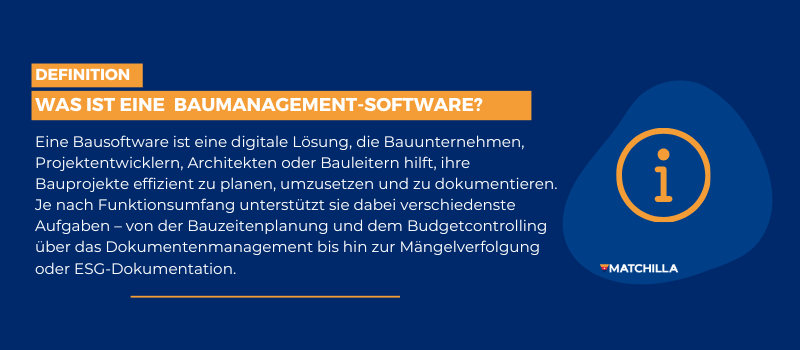
Before we go deeper into the selection process for construction software, one thing must be said: There isn’t just one type of tool with a fixed number of providers. Depending on the project type and the size of the company, systems vary widely—from specialized tools for individual processes (e.g., site diary, construction schedule, subcontractor communication) to comprehensive platforms that connect all project stakeholders and map the entire life cycle of a construction project. So you should first identify which software solution fits your requirements.
In the end, it’s always about increasing your transparency, reliability, and speed on your construction sites, as well as minimizing the typical friction losses between planning, execution, and documentation internally and across your supply chains.
Let’s start the selection process to find the right construction software solution according to your criteria with a market overview for Germany, Austria, and Switzerland.
The market for construction software for businesses in the German-speaking region has gained significant momentum in recent years. By now, there are digital solutions for small craft businesses all the way up to large general contractors with massive construction projects. This not only ensures a wide range of tools, but also brings many challenges when comparing software.
For an initial overview, we broadly divide the more than 100 construction software providers in the DACH region into three categories:
Standalone solutions for construction management areas
These tools usually focus on a clearly defined area—such as estimating, the construction diary, time tracking, or defect management. They are perfectly optimized for specific requirements, but can only be combined with other tools to a limited extent.
Target group: SMEs or clearly defined requirements for a specific use case.
Modular construction management software suites
These providers offer multiple functions in one package—usually on a single platform. Companies can book modules individually (for example, for tendering, project planning, site communication, or materials planning) and expand them as needed.
Target group: Mid-sized construction companies with multiple site managers.
ERP systems for the construction industry
These systems cover many cross-functional processes—from estimating and accounting to equipment deployment planning. They are often ERP systems specifically adapted to the construction industry.
Target group: Large construction companies or groups with multiple construction projects.
Before you start your search for construction software, you should get a clear picture: How complex is your project management? Who is involved (site management, architecture, external partners)? What are your short- and long-term goals?
Once these questions have been clarified, you can realistically assess your actual needs. This way, you can find the solution that fits your requirements and your budget. (More on ROI can be found further below.)
Suitable construction software for companies is more than just a digital tool – it supports smooth collaboration with your suppliers and ensures transparent, efficient workflows.
With the right features, it also strengthens business relationships, simplifies processes, and lays the foundation for long-term, reliable partnerships.
The most important features of a construction management tool include:
Project & construction scheduling
Enables detailed time and resource planning, for example with Gantt charts, construction schedules, and milestones. Adjustments due to weather, delivery issues, or staff shortages can be incorporated flexibly.
Practical example:
A construction manager plans the structural work for three trades in parallel. When one trade reports a delay, they adjust the sequence directly in the tool – the subsequent trades receive automated updates and costly downtime is avoided.
Document management & plan versioning
All documents (e.g., plans, bills of quantities, permits) are managed centrally. There is versioning, approval workflows, and clear access rights – including mobile access on the construction site.
Cost and budget control of construction projects
Provides a real-time overview of planned vs. actual costs. Bills of quantities, change orders and invoices are assigned directly to the budget and reviewed for profitability.
Practical example:
The commercial management identifies early on that the development costs are 15% above plan. With one click, it generates a cost report for the management team – a basis for decisions on budget adjustments.
Construction site management & defect tracking
Enables mobile capture of daily construction reports, photos, defects, working hours and safety inspections – all documented and with follow-up reminders. For the construction machinery in use, maintenance and servicing management is organized and tracked.
Practical example:
A foreman reports a crack in the floor slab via app, marks it on the plan and assigns it to the responsible company. The project manager is notified automatically – with a deadline and tracking.
Tendering & Award Management (AVA)
Creation and dispatch of bills of quantities, bid comparisons, and legally compliant award documentation – often with a connection to price databases.
Practical example:
The technical department tenders the “façade” trade digitally. Within a few days, comparable bids are available, which the system automatically checks for plausibility and completeness.
In an increasingly competitive construction industry, well-implemented and properly used construction software is a strategic advantage that secures your competitiveness in the long term and focuses on shared goals and strategic partnerships to grow together and remain successful – and suitable construction software helps to get the best possible out of these aspects.
A particular advantage: Most tools can often be integrated into existing systems, such as the ERP, without any issues and linked with additional software solutions.
With the software features described, you not only optimize your internal processes and save costs – you also create a valuable data foundation. This becomes particularly relevant when you participate in (public) tenders or need financing for projects. Because: the documented information feeds directly into your ESG scoring – a factor that is becoming increasingly important in construction practice.
But what does ESG actually mean in the construction context?
Environmental: Environmental aspects in the construction industry
Reduce CO2 emissions, more resource-efficient use of materials, waste management & disposal, energy consumption & construction site logistics
Social: Responsibility on the construction site and in the supply chain
Occupational health protection and occupational safety, fair working conditions & compliance in the supply chain as well as documentation & training
Governance: Clean processes, clean projects
Occupational safety & health protection, fair working conditions & compliance in the supply chain as well as documentation & training
Many of these ESG-relevant topics can be mapped directly via modules in modern construction software – structured, traceable, and audit-proof.
Most tools in the construction sector do not offer direct reporting functions or emissions calculators, but they do provide key data for many sustainability KPIs. They therefore form the basis for analyses and future ESG reporting and make it easier to capture relevant data.
Especially for topics such as CSRD, EUDR, and LCA/life cycle assessments, additional tools are usually necessary to meet all requirements. Many ESG tools can use the information stored in construction software to calculate and analyze relevant data.
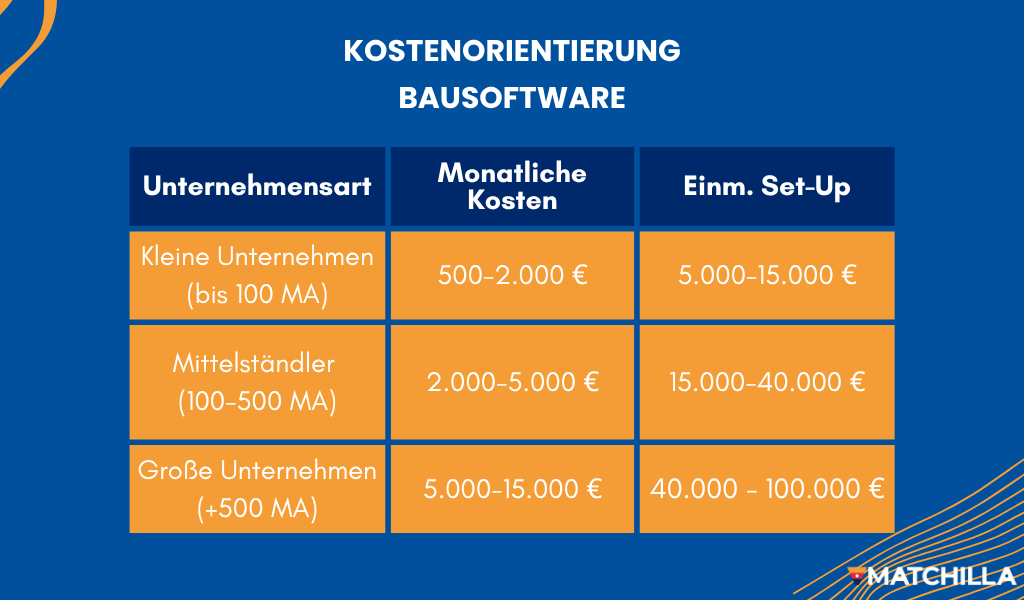
The benefits of software are indisputable, but of course the investment needs to pay off for you—both in terms of time resources and budget. However, the costs for construction software vary and therefore cannot be stated as a flat rate (at this point in time).
While smaller companies can start with a modular basic solution, larger businesses often need a custom-made software solution that maps complex supply chains and international partners. As a result, average monthly costs range between €500 and €50,000.
The following factors, among others, are decisive for the actual investment:
Size and structure of the company
Required functions
Number of access rights
Support services
Maintenance
Integration into existing systems
The following table provides guidance on license costs as well as the initial effort required for implementation (including internal project costs):
ROI calculation for construction software for mid-sized companies
Company profile:
300 employees (planning, construction management, administration, execution
Projects per year: approx. 80–100 construction projects (medium to large)
Pain points
Many tools and data silos → no end-to-end control
High coordination effort between departments & construction sites
Non-transparent post-calculation, making it harder to safeguard margins
Time losses in material and capacity planning
Costs of the construction software
On the one hand, the total costs are clearly set out in the contract with the software provider, but your internal resource deployment in project management and for training must of course also be factored in.
License costs (cloud/SaaS, integrated solution): €90,000
One-time implementation & interfaces: €40,000
Training costs (incl. admins, key users, etc.): €10,000
➡️ Total investment in year 1: €140,000
Benefits analysis of construction software
Now let’s look at the other side of the scale and estimate the monetary benefit you can expect from investing in construction software.
Reduced project control time (10–15%): €60,000
Improved resource planning & utilization: €40,000
Faster invoicing & liquidity gains: €25,000
Fewer defects thanks to plan management & checks: €35,000
Better change order management (e.g., through documentation): €50,000
Transparency & control across all projects: €30,000
➡️ Total benefit in year 1: €240,000
ROI calculation
ROI = (benefit – investment) / investment
➡️ Year 1 = (€240,000 – €140,000) / €140,000 = 0.71 → 71% return
🧮 Break-even: approx. 7–8 months after implementation
Conclusion: For a construction company with 300 employees, the economic leverage is massive because many small efficiency improvements have a multiplied effect—across departments, construction sites, and months. The ROI is already high in the first year, and it increases significantly in the second year, as the implementation costs are completely eliminated.
Tip: In our matching process, you can ask providers for an initial price indication if you complete the criteria in our Match Assistant below in full. This way, you can quickly and easily get an initial price benchmark.
The market for construction software in the DACH region is dynamic and includes both major international providers as well as medium-sized and specialized companies. There are around 100 relevant providers offering different solutions for the construction industry. However, this can make researching the right tool confusing and time-consuming. The good news: We’ll take care of it for you!
With our matching process, we offer a structured and effective method to find the right software solution for you. This saves you valuable time and a lot of research effort.
We draw on experience from over 30 matchings for mid-sized companies and construction groups, as well as our unique database containing the most relevant tools for the German-speaking market. We have evaluated them using hard and soft criteria—such as features, interfaces, industry expertise, pricing, and much more—and can compare them with your company’s needs. You will then receive an individual shortlist of the three software providers that fit you best.
The best part: The comparison is non-binding, free of charge, and anonymous towards the providers.
Would you like to find out which software best supports you in optimizing your construction management? Then take a few minutes and fill out our Match Assistant or search directly on our platform!
We look forward to matching with you!
Providers in matching: 29

Matchilla’s approach is brilliant: I no longer have to laboriously research consultancies and software providers and fight my way through countless comparison portals – the right providers come to me, so to speak – with just a few minutes of effort. The matching process saves us many resources.

Finding suitable service providers is easy and super fast with Matchilla. Getting in touch, defining specifications, and after just a few days the results were there. Through this approach, we obtained information about providers we hadn’t heard of before. Real added value.

I was convinced by Matchilla’s short, clear paths: Our specific need is understood immediately, analyzed perfectly, and matched with the right providers in a short time. Matchilla’s platform works quickly, straightforwardly, and guides you precisely through the service provider selection process.
We have described in detail in this article what is important when choosing suitable construction software—because the search for suitable providers and the decision-making process can quickly become complex and time-consuming.
Our structured matching process has already proven itself in numerous projects with medium-sized companies and corporations. In doing so, we have encountered just about all scenarios when selecting tools in construction management. Thanks to the large number of matchings carried out, we have a unique database that cannot be found in any AI.
In combination with our market overview and our practical experience in the software sector, this gives you a clear knowledge advantage. You not only save yourself the laborious task of doing your own research, but you also reach the right provider efficiently and in a targeted manner via the Matchilla platform.
Matchilla’s service is free of charge, non-binding, and anonymous towards the providers. The individual analysis to select the best software as well as the provision of detailed background information are financed through the providers’ platform fees. In general, we are not in any paid contractual relationship with you. You always remain in control of selecting and completing the matching process and can end it at any time.
Simply start by filling out the Match Assistant. This gives us an initial insight into your requirements. We will contact you personally if further specifications are needed—based on experience, additional exchange is necessary for construction software matchings. So feel free to block 15 minutes for a clarification call with Matchilla 😉
This way, we sharpen the selection criteria and include additional individual decision factors beyond the standard data in the matching. Based on the aggregated information, we create the matchboard on our platform with the tool providers most relevant to you.
The Matchilla platform can be used for an official tender for supplier relationship management software. In addition to the existing information about the providers, you collect the relevant offers directly on the matchboard. Using the invite function, you then share all information not only with procurement, but optionally with everyone involved in the process within the company.
With this methodology, Matchilla creates an individual provider competition for your specific matching request, making prices more comparable and negotiable for you. That will make procurement, your boss, and your own budget happy!
The selection process is based on an efficient interaction of data, algorithms, and a solid portion of personal expertise. No matchboard is released without one of our experts adding their own input.
Think of Matchilla as a neutral sparring partner in this software selection process. We want your company to continue using the services of the Matchilla platform for many more searches for service providers in the future. That’s why we are highly interested in ensuring that you not only access an excellent procurement process, but also ALWAYS find the best possible providers through us.
Try it/us with no obligation – we look forward to matching with you!
René Kühn is the founder and managing director of Matchilla. Together with his team, he has built one of the best market overviews of software providers and service providers on the matching and procurement platform.
Ihr seid auf der Suche nach einem Compliance-Managament-System, das Eure Prozesse optimiert? Wir…
Ihr wollt die wachsenden Aufgaben im Risikomanagement durch eine (neue) ERM-Software professionalisieren? Das…
Ihr seid dabei Euch auf die Anforderungen des BFSG vorzubereiten und sucht nach…