CSR Software – Why Companies Need Sustainability Software Now

Corporate Social Responsibility (CSR) and sustainability management present companies with new tasks and requirements. The legal framework for creating reports requires the use of CSR software to set up processes optimally.

S

ustainability, reporting, CO2 emissions! Which company, which marketing and CSR department isn’t talking about them? It’s one of the most important societal topics of the 2020s.

Did you know that there are tools and software applications to manage, track, and improve sustainability? Let’s focus on the selection process for CSR software. Because sooner or later, your company will need a technical solution due to the EU’s CSR directive to manage the many processes involved. This article gives you a perfect overview of the current challenges and supports you in choosing the right CSR software providers.

CSR software in focus

What does CSR software do?

The basics: CSR stands for Corporate Social Responsibility. The general definition by the United Nations Industrial Development Organization is as follows:

“Corporate Social Responsibility is a management concept whereby companies integrate social and environmental concerns in their business operations and interactions with their stakeholders. CSR is generally understood as being the way through which a company achieves a balance of economic, environmental and social imperatives (“Triple-Bottom-Line-Approach”), while at the same time addressing the expectations of shareholders and stakeholders.“ (Source)

The abbreviation CSR also stands for Corporate Sustainability Reporting. The next section is about the changes to reporting.

Now the second part, the software: Put simply, you use CSR software for your sustainability management. You systematically consolidate data from various sources and get a real overview on a dashboard, e.g., of your CO2 emissions. You then create your sustainability reports from it. It’s clear that this is no longer possible with Excel or other solutions. Supply chains are too complex, data volumes too large. And CSR software presents all data in an appealing way.

With the right software, your company has everything in one place and saves an enormous amount of time and stress. You manage the data in one place, work on it with your colleagues, and define workflows. You increase the convenience of the entire process all the way through to reporting. The reports—and their accuracy—are the key point. 

The term “CSR” is being used less and less following the massive market developments of recent months. It is increasingly being replaced by ESG and/or CSRD (Corporate Sustainability Reporting Directive).

Why do we need CSR software? What does the EU’s new CSR directive say?

First, it should be clear that sustainability management is not a nice-to-have, but a must-have. It’s simply good form for companies to operate sustainably—and they’re welcome to use that for image-building. With the right tool, you have it in black and white on your screen how sustainable you actually are. You can read more about its role as a marketing factor further down.

Second, your company may soon fall under the CSR reporting obligation. And now we come to the tricky part: the European Union’s new Corporate Sustainability Reporting Directive (CSRD).

The EU Parliament adopted it on November 10, 2022; on December 16 it was officially published in the EU’s Official Journal. Twenty days later it entered into force. That means: all EU countries must now transpose the directive into national law within 18 months—i.e., by around mid-2024.

Ernst & Young summarizes it like this: “More companies will in future have to report more extensively and be subject to external audit requirements. So far, the two objectives of climate protection and adaptation to climate change are described in particular detail.” (Source)

We continuously prepare all updates around the CSRD and inform you about the new obligations coming your way, via newsletter.

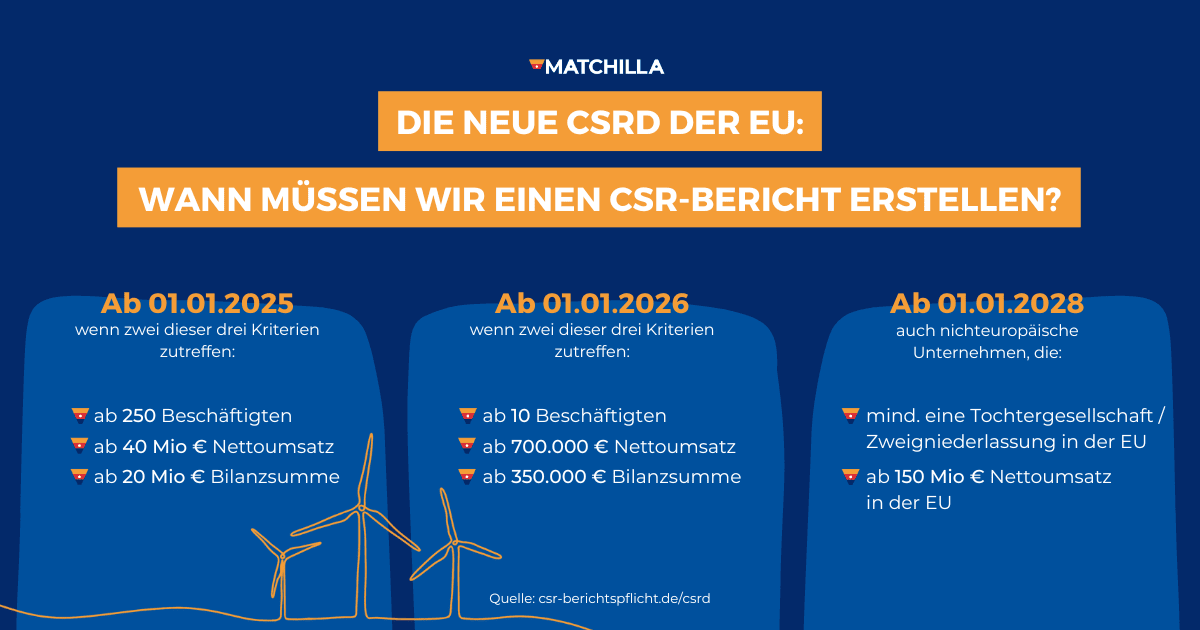
Grafik: Kriterien für die CSRD-Berichtspflicht VOR dem Omnibus
Grafik: Kriterien für die CSRD-Berichtspflicht

Key changes under the CSRD

The main reason why the CSRD is causing such an upheaval is that thousands more German companies than before will be subject to reporting requirements. This is because, in the coming years, the company size threshold will be gradually lowered. Here is the timeline:

For financial years starting on 1 January 2024 – first reporting in 2025

Public-interest entities with more than 500 employees. These are the companies that are already subject to the NFRD (since 2017, this includes large listed companies, credit institutions and insurance companies in the EU).

For financial years starting on 1 January 2025 – first reporting in 2026

All other large companies under accounting law. These are companies to which two of the following three criteria apply:

Matchilla - Matching-Plattform und Marktplatz From 250 employees on average over the year

Matchilla - Matching-Plattform und Marktplatz Net revenue of more than 40 million euros

Matchilla - Matching-Plattform und Marktplatz Balance sheet total of more than 20 million euros

For financial years starting on 1 January 2026 – first reporting in 2027

All capital market-oriented SMEs (with the exception of micro-enterprises) as well as small and non-complex credit institutions and captive insurance undertakings. Here too, two of the following three criteria apply:

Matchilla - Matching-Plattform und Marktplatz From 10 employees

Matchilla - Matching-Plattform und Marktplatz Net turnover of more than 700,000 euros

Matchilla - Matching-Plattform und Marktplatz Balance sheet total of more than 350,000 euros

However, SMEs have the option of a deferral until 2028.

Further key innovations of the CSRD

Matchilla - Matching-Plattform und Marktplatz The reporting content must become significantly more extensive and more specifically geared towards climate action. It will therefore become more demanding.

Matchilla - Matching-Plattform und Marktplatz Sustainability information is to become a mandatory part of the management report in future.

Matchilla - Matching-Plattform und Marktplatz Last but not least, the external audit requirement for sustainability reports will be introduced. This means it will be audited more closely.

So there isn’t much time left to act. At the very latest, get informed now whether and when you are affected by the reporting obligation. You can find more information on this topic at frankfurt-main.ihk.de, at KPMG or on the portal csr-in-deutschland.de, which is run by the Federal Ministry of Labour and Social Affairs.

Hopefully that didn’t sound too threatening (2024! External audit requirement! From 250 employees!). Let’s draw a line under it and move on to the reassuring part of the new challenges: there are tools available for the upcoming tasks. CSR-management has long since arrived in the technology age. The right CSR software guides you through the jungle of regulations, where Excel & Co. get tangled up in the lianas of legal paragraphs.

CSR Software: CSR-Management ist längst im Technologiezeitalter angekommen

What categories of CSR software are there?

CSR is a fairly young category in the software market. As with almost all software types, it’s not possible to draw a clear line as to what exactly CSR software is. In some cases, it appears as a component of larger EHS platforms (Environment, Health and Safety; also HSQE, Q for Quality) or ESG platforms (Environmental Social Governance).

Another variant is CO2 management software. If you need to check your suppliers’ sustainability (keyword: Supply Chain Act, which came into force in January 2023), then software for monitoring your suppliers for sustainability is the right choice for you. And you will come across providers that label their software as pure CSR software.

What are important features of CSR software?

More important than the question of what the software label is are the features. Do they fit your requirements and your infrastructure? In the end, the correct reports must come out according to the specified standards—from DNK to GRI to CSRD. All software providers deliver that. However, there are differences along the way and in usability.

A possible feature set

Matchilla - Matching-Plattform und Marktplatz Workflow management and task function

Matchilla - Matching-Plattform und Marktplatz Internal messaging, chat and commenting function

Matchilla - Matching-Plattform und Marktplatz Involving employees

Matchilla - Matching-Plattform und Marktplatz CSR measures management

Matchilla - Matching-Plattform und Marktplatz CSR content hub

Matchilla - Matching-Plattform und Marktplatz CSR goals tracking

Matchilla - Matching-Plattform und Marktplatz KPI management

Matchilla - Matching-Plattform und Marktplatz Store your own guidelines

Matchilla - Matching-Plattform und Marktplatz Hotspot analysis

Matchilla - Matching-Plattform und Marktplatz CO2 reduction tracking

Matchilla - Matching-Plattform und Marktplatz Interfaces for data integration

Matchilla - Matching-Plattform und Marktplatz Checking data for plausibility and completeness

Matchilla - Matching-Plattform und Marktplatz Real-time calculations

Matchilla - Matching-Plattform und Marktplatz Conversion of units and currencies

Matchilla - Matching-Plattform und Marktplatz Exporting data to other systems

Matchilla - Matching-Plattform und Marktplatz Reports in corporate design

Matchilla - Matching-Plattform und Marktplatz Interactive reports

This is only an excerpt of the functions. You can see that CSR software can do more than importing data and exporting reports. That doesn’t exactly make it easy to choose the systems that fit your requirements – we’ll get to that in a moment.

How do I use CSR software for our marketing?

CSR software isn’t only useful for meeting guidelines. That’s the primary purpose. On a second level, you can get even more out of it for your company. After all, it’s not just the EU asking you to communicate your sustainability more clearly. Your customers increasingly expect it from you as well. They don’t want to see pretty pictures on the website; they want data-based facts about your emissions (KPI vision: CPC via views on sustainability reports).

If you don’t provide that and present it transparently, you may soon face a loss of image and a downstream competitive disadvantage. In that respect, CSR software will develop into an indispensable part of your MarTech stack in the near future.

How do I find the CSR software that’s right for me?

You’ve probably been asking yourself this question for a few lines now. As you can tell from this content, we at Matchilla deal with this topic intensively and continuously and carefully screen the provider market. Our database contains over 150 ESG software providers from Europe and especially the German-speaking region, which we have clustered and evaluated according to various criteria.

What this means for you: you only need to invest a few minutes and you will be presented with three CSR software providers as suggestions – selected precisely according to your individual needs. How does it work? With Matchilla’s matching process.

Start the CSR software matching assistant below now and easily match with the right providers instead of searching for them in a time-consuming and tedious way.

Free and non-binding matching: CSR software

    • 1

      Start

    • 2

      Spezifikationen

    • 3

      Projekt

    • 4

      Kontakt

    1/4

    Start

    Match-Assistant: CSR- und ESG-Software

    Bitte beachtet: Umso detaillierter die Angaben, desto individueller die Matching-Ergebnisse. Bei Fragen stehen wir euch unter [email protected] oder 0221 – 292 5676-0 zur Verfügung.

    Nutzt ihr bereits eine CSR-Software?
    Fällt euer Unternehmen unter die seit 2024 geltende Corporate Sustainability Reporting Directive (CSRD) der Europäischen Union?

    Spezifikationen an die Software

    Welche Funktionen und Anforderungen sind euch wichtig?

    Bei welchen Aufgaben im Nachhaltigkeitsmanagement soll euch die Software unterstützen?
    Werden mehrere Personen im Unternehmen das Tool bedienen? Benötigt ihr eine Nutzerverwaltung?
    In welchen Sprachen muss die Bedienoberfläche verfügbar sein?
    Sucht ihr aus DSGVO- und Supportgründen bevorzugt nach deutschen oder europäischen Anbietern?
    Falls ihr euch bereits intensiver mit den Funktionen einer CSR-Software befasst habt, welche Funktionen benötigt ihr unbedingt?

    Das Projekt bei euch

    Euer Status quo in Sachen Nachhatigkeit und weitere wichtige Informationen für die Auswahl der Anbieter

    Welche Standards müssen eure Reportings erfüllen?
    Wo steht ihr selbst intern beim Thema Nachhaltigkeit?
    Einige Softwareanbieter bieten eine Strategieberatung sowie eine Prozessbegleitung in Kombination mit der Softwarelösung an. Ist das für euch relevant?
    Wo hat euer Unternehmen Standorte?

    Wieviele Mitarbeitende hat euer Unternehmen insgesamt?

    Für die Materialitätsbestimmung: In welcher Branche seid ihr tätig?

    Zu welchen bestehenden Systemen benötigt ihr eine Schnittstelle? (z.B. für den Datenimport und -export)

    Welchen Budgetrahmen pro Jahr habt ihr vorgesehen?

    Warum sucht ihr derzeit eine CSR-Software? Welche Ziele möchtet ihr damit erreichen? Welche weiteren Kriterien sind euch wichtig?

    Deine Kontaktdaten

    Vielen Dank für die Angaben! An dieser Stelle benötigen wir deine Kontaktdaten, um dir die individuelle Shortlist (Matchboard) mit den drei passendsten CSR-Softwarelösungen zuzusenden. Unser Service ist für euch als Suchende unverbindlich, kostenlos und anonym. Die persönlichen Daten werden nicht mit den Anbietern geteilt.

    How CSR matching works

    Why is the selection process with Matchilla better than with others?

    First off: We’re not one of those countless listing platforms with standardized profiles that have to rely on input from providers. Behind this article is an innovative platform for structured procurement processes and a real team of experts. Our service is a mix of software comparison, tendering portal, and individual consultation for vendor selection. Absolutely unique!

    We’ve built up our unique market overview, high data quality, and direct contact with providers ourselves through more than 500 ESG matchings. Every day, we support our customers during tool presentations and are involved in the final decisions. Which CSR software provider was selected in which industry—and for what reasons? We can tell with just a few clicks and short research in our matching history.

    What information do I get at Matchilla?

    The CSR market for tech and consulting has grown immensely in recent years. This article originally dates back to summer 2022—and how the ESG/CSRD software landscape has changed since then is tremendous.

    What has emerged is a veritable jungle of different regulations such as CSDDD, PCF, LCA, EUDR etc., as well as the associated technical solutions. For companies searching, this is extremely confusing—and prices sometimes come from the far side of the moon. This is exactly where our expertise lies, and what we want to highlight: We not only identify the relevant software providers, but also put them into competition for your requirements via our platform. 

    On Matchilla, you don’t just compare standard information—you also get insights from our previous matchings and, in the subsequent decision-making process, have the opportunity to compare concrete offers. A dedicated, small marketplace is created just for this one need. At Matchilla, competition doesn’t just invigorate providers’ business.

    How can you be sure that the selection is neutral?

    The question our team gets asked most often: You’ll probably pick the providers that generate the highest revenues for Matchilla and have an account with you, right? A completely understandable question—and to eliminate this skepticism, here are a few more detailed points:

    1. In the ESG software market (DACH), over 90% of providers have a profile in our database. We’d be happy to explain personally what types of solutions these are. That means our coverage is immense, and we definitely select from the most relevant offerings.

    2. Matchilla has such market relevance as a sales channel for providers that our standard terms are the same for everyone.

    3. You negotiate the prices directly with your preferred providers. The three providers on the matchboard know they are competing against each other and that right next door there are two competitors who can also support you very well.

    4. The most important point: On Matchilla there are numerous other categories for matchings across consulting, software, and agencies. ESG is one of our focus topics alongside GRC (Governance, Risk & Compliance), but it’s far from everything. We also know that you’ll automatically recommend us across your company if we deliver sustainable value for you. The collaboration should by no means end in a one-shot. Our mission is to be available to you as a neutral sparring partner on many other topics as well. So it’s a chance for you to find CSR software as efficiently as possible and with a likeable expert—and for us to convince a new platform user of our service.

    One last clear recommendation: Try Matchilla with no obligation. Our team is straightforward, open, and always available. And the benefits of the platform are guaranteed to convince you.

    Now we’re looking forward to the matching with you!
    Picture of About the author
    About the author

    Ulrich Theves is Head of CSR Matching at Matchilla and is deeply involved with technical solutions (i.e. software and tools) in the field of sustainability. He has one of the best overviews of the market and shares his expertise in the MatchZINE.

    CSRD, Lieferketten, EUDR, ESPR, PPWR, CBAM & Co. sind Themen, die alle Unternehmen betreffen. Wir teilen im MatchZINE unser geballtes Praxiswissen aus über 1.000 Matchings für Mittelständler und Konzerne.

    More articles on ESG & CSR